
The proceedings brought by South Africa before the International Court of Justice concerning Israel raise questions that extend far beyond the dispute itself. They concern the effectiveness of international law, the binding nature of the Court’s orders, the evidentiary threshold for genocide, the possible responsibility of states that assist unlawful conduct, and the international system’s ability to enforce judicial decisions.
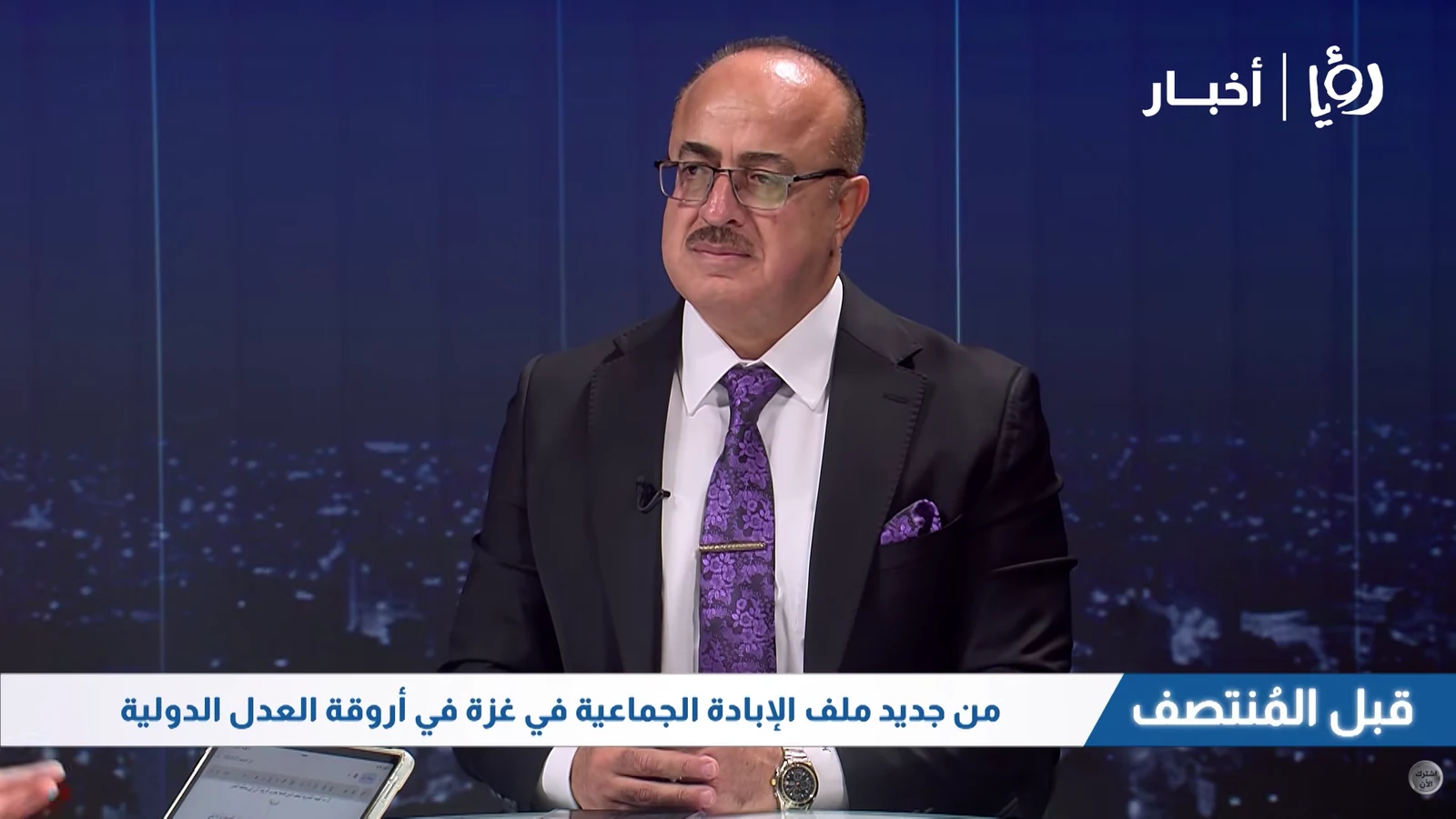
During an interview on Roya News, KLEON Founder, Chairman and CEO Dr. Ibrahim Al-Hunaity explained that South Africa’s latest submissions should not be treated as an entirely new case. They form part of the proceedings already before the Court and introduce additional material concerning alleged non-compliance with measures previously ordered.
Their significance is not limited to immediate procedure. Evidence of conduct continuing after provisional measures have been issued may later form part of the broader factual and legal record assessed by the Court.
Provisional Measures Are Not a Final Judgment
A central distinction is the difference between provisional measures and a final judgment. The Court has not yet made a final determination on whether genocide has occurred. At the provisional stage, it ordered measures intended to preserve protected rights and prevent further harm while the case proceeds.
The Court must ultimately examine the submissions of both parties, assess the full evidentiary record, and reach its conclusions at the end of the proceedings. Reports and events arising after the provisional orders may therefore strengthen or alter the material considered in the final assessment.
How the Court Assesses Events on the Ground
The International Court of Justice is not an investigative authority operating on a battlefield. It does not collect evidence in the same manner as a domestic police or prosecutorial body.
Instead, it assesses material placed before it, including reports from international organizations, human-rights bodies, monitoring institutions, and other credible sources. Documentation concerning civilian casualties, displacement, humanitarian conditions, access to food and assistance, military operations, and compliance with earlier orders may all become relevant.
Public concern alone does not determine the legal outcome. Each element must be assessed against the applicable evidentiary and legal standards.
The Difficulty of Proving Genocidal Intent
One of the most demanding elements in genocide litigation is proving specific intent. A state is unlikely to declare openly an intention to destroy, in whole or in part, a protected national, ethnic, racial, or religious group.
Intent may therefore need to be inferred from conduct. The Court may examine the persistence and scale of particular acts, the methods and weapons employed, the treatment of civilians, restrictions on humanitarian assistance, and the wider pattern demonstrated by the evidence.
Dr. Ibrahim emphasized that this determination depends upon the Court’s evaluation of the totality of the record. Continued conduct after judicial orders have been issued may become a significant part of that evidentiary picture.
Legal Authority Versus Practical Enforcement
The most difficult issue may not be whether international courts possess legal authority, but whether their decisions can be implemented effectively. Orders and judgments of the ICJ carry legal weight, yet the Court has no police force, military force, or independent authority capable of physically compelling compliance.
Implementation therefore depends largely on states and the wider United Nations system, particularly political action through the Security Council. This creates an enduring tension between legal obligation and political reality.
Where a state benefits from the support of a permanent Security Council member, the possibility of a veto can limit the international community’s ability to translate a judicial decision into practical measures. The weakness lies less in the Court’s judicial reasoning than in the institutional structure responsible for enforcement.
A Structural Weakness in the International System
The situation raises a broader question: should implementation of international judicial decisions ultimately depend on the political positions of five permanent Security Council members?
Dr. Ibrahim argued that international justice needs a meaningful mechanism capable of responding when the Security Council cannot act on serious violations of international law. The protection of fundamental rights should not depend entirely on geopolitical alignment.
An effective enforcement framework would give practical force to ICJ decisions while preventing political considerations from overwhelming the judicial process.
Can Responsibility Extend to Other States?
Legal responsibility may potentially extend beyond the state directly accused of prohibited conduct. If another state is alleged to have assisted, facilitated, or contributed to unlawful acts through weapons, intelligence, or other support, questions of responsibility may arise.
Such responsibility is not automatic. A claim against an assisting state must be properly brought before a competent international judicial body and supported by evidence establishing the state’s involvement. Political allegations alone cannot replace the required legal procedure.
The Continuing Role of the International Community
The international community’s responsibility does not begin and end with the ICJ proceedings. States may participate in legal processes where permitted, support the evidentiary record, and continue raising alleged violations before the relevant United Nations institutions.
Dr. Ibrahim stressed the importance of sustained diplomatic and legal action through both the General Assembly and the Security Council. The Council’s responsibility for international peace and security exists independently of the Court’s eventual final judgment.
International action therefore need not wait for years of proceedings to conclude before responding to serious developments.
Gaza’s Humanitarian Conditions and the Evidentiary Record
Conditions on the ground remain legally significant. Civilian casualties, displacement, humanitarian deprivation, food insecurity, restrictions on assistance, and the broader treatment of the civilian population may form part of the evidence used to evaluate both conduct and intent.
Those circumstances do not automatically determine the Court’s final conclusion, but the worsening humanitarian situation may influence further interim measures and, ultimately, the Court’s assessment of the case.
A Test for International Justice
The proceedings represent more than a dispute between two states. They test the international legal system itself. The Court can examine evidence, interpret international conventions, establish responsibility, and issue binding decisions. It cannot independently supply the machinery required to enforce them.
That responsibility remains with the international community. If international law is to offer genuine protection rather than declarations alone, judicial authority must be accompanied by an effective means of implementation.
Confidence in international justice requires both an independent court and a system capable of enforcing its decisions without making law subordinate to political interests.
Can the international legal system ensure that the rules binding states are enforced equally when law and global politics collide?